



Marina Bay is an academic service design project developed in a university extension study group. The project applies service design methodologies to map and design the experience journeys of a fictional high-end hotel, exploring touchpoints, opportunities for improvement, and the creation of memorable experiences.
01 / SUMMARY
02 / Process
03 / Service design
04 / Marina Bay
05 / Journey map
06 / Service blueprint
07 / Final considerations
02 / PROCESS
introduction
>
context
>
research &
immersion
>
journey
>
conclusions
INTRODUCTION
03 / SERVICE DESIGN
Service design is a strategic discipline that expands the scope of UX beyond digital interfaces, considering the user experience in a systemic way. The approach integrates people, processes, channels, and business operations, mapping touchpoints, stakeholders, and flows that support the service from end to end. This perspective is especially relevant in complex services, with multiple actors and interactions distributed between physical and digital environments.
CONTEXT
04 / MARINA BAY
RESEARCH AND IMMERSION
05 / JOURNEY MAP
With the context clearly defined, I moved on to mapping stakeholders, identifying all the actors involved in the Marina Bay experience, such as guests, operational staff, managers, suppliers, and physical and digital channels. This exercise allowed me to understand how responsibilities, expectations, and interactions relate to each other throughout the service. Based on this mapping, three main proto-personas were defined: the corporate guest, the family on vacation, and the couple on their honeymoon. To deepen the analysis, the project focused primarily on the corporate guest, using this profile as a reference for detailing the journey.
The journey was structured into key phases—discovery and research, reservation and pre-check-in, check-in and reception, stay and consumption of services, check-out, and post-stay. At each stage, contact points, guest emotions, and operational challenges were analyzed, allowing us to identify friction points, gaps in the experience, and opportunities for improvement that guided design decisions throughout the project.
THANK YOU!


The Marina Bay project was developed as a final course project for the Service Design program, a university extension program at Anhanguera University Center. The program combines theoretical foundations, practical tools, and guided application, with a focus on developing services aligned with business strategy. The goal of this project was to apply this methodological framework in a context close to reality: the operation of a fictional luxury hotel.
Click on the image to read the blueprint and the definition of the proto-personas (in Brazilian-Portuguese). You will be directed to a Figma link.
Scope
Marina Bay is a fictional five-star hotel with 20 years of experience in the hospitality industry, located in a prime area. Its structure includes:
200 rooms spread over 15 floors; Executive suites, premium rooms with sea views, and standard accommodations;
24/7 operation, with an average occupancy rate of 75%;
Full accommodation services (room service, restaurant, spa, gym, and event spaces);
Multidisciplinary operational team; Digital reservation system with pre-check-in and proprietary app;
Loyalty program with over 8,000 active members.
During high season, the hotel operates at close to 100% occupancy, which requires a high level of operational efficiency, agile service, and personalization of the guest experience.
The project began with an immersion phase, dedicated to gaining an in-depth understanding of the hotel's context and the challenges involved in its operation. The focus was on building a systemic view of the service, analyzing both the guest's perceived experience and the internal processes that make it possible. At this stage, we investigated the expectations, needs, and behaviors of guests throughout their journey, considering different profiles and contexts of use. At the same time, I analyzed the hotel's organizational structure and operational flows, seeking to understand how internal decisions directly impact the experience delivered. I also observed the interactions between staff and customers at different points of contact, in addition to evaluating existing systems and tools, with the aim of identifying bottlenecks, redundancies, and opportunities for improvement.
Stakeholders and journey






JOURNEY
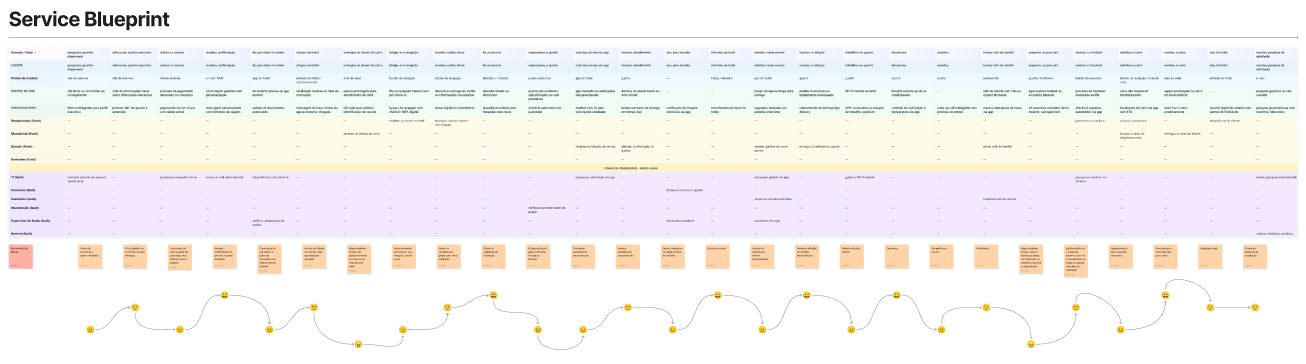
A service blueprint is a strategic service design tool that allows you to visualize, in a structured and systemic way, how a service works from end to end. It connects the user experience to internal operations by mapping, in layers, the customer journey, visible touchpoints (frontstage), internal processes invisible to the user (backstage), and support systems and resources. By making the relationships between people, processes, and technology explicit, the service blueprint helps identify flaws, dependencies, and opportunities for improvement, promoting alignment between teams and more consistent design decisions oriented toward the experience and the business. The central stage of the project was the construction of a complete service blueprint, used to visually and integrally represent the relationship between the guest experience and service operation. The blueprint consolidated:
The phases of the guest journey;
Frontstage contact points and systems;
Backstage operational processes and flows;
Infrastructure, channels, and support tools;
Performance indicators and desired experiences.
The guest journey served as the structural basis for the blueprint, functioning as an organizing axis for the other layers. From there, interactions visible to the user were positioned, followed by the internal processes that support these interactions.
In the frontstage layer, the guest's direct contacts with the service were mapped, including human service, physical environments, and digital interfaces. The backstage layer detailed the internal flows, communications between areas, and decision-making that, although invisible to the customer, directly impact their experience. Finally, the support and infrastructure layer identified the systems, technologies, and resources necessary to enable consistent operation. This visualization made it possible to identify critical dependencies, points of failure, and opportunities for optimization, in addition to promoting a shared vision of the service among different areas of the operation.
06 / SERVICE BLUEPRINT
CONCLUSIONS
07 / FINAL CONSIDERATIONS
Use of Artificial Intelligence
Throughout the project, I used artificial intelligence tools to support the design process, especially in the early stages. Claude.ai was used to organize discovery information, synthesize insights, and support the structuring of strategic thinking. UXPressia was adopted to build the visual service blueprint, enabling a clear and integrated representation of the journey, touchpoints, and frontstage and backstage processes.
Key learnings
Next steps
The development of the project reinforced important lessons, including:
The need to go beyond the interface and consider the experience as a system;
The strong interdependence between internal processes and user perception;
The value of visual artifacts, such as journeys and blueprints, for alignment between teams;
The importance of balancing impact on the guest experience and operational efficiency.
As a result of the project, opportunities were identified to:
Develop prototypes of digital services, such as app upgrades and self-service solutions;
Evolve the service blueprint into an implementation roadmap with clear metrics;
Explore the use of emerging technologies, such as chatbots and personalized recommendation systems.