



Payment Retry for Natura's LATAM Hispanic E-commerce
At Natura, I was the Product Designer responsible for the e-commerce experience across the Hispanic Latin American operation, covering Argentina, Chile, Colombia, Ecuador, Mexico, and Peru. Working in an international environment, I collaborated closely with the product trio, alongside Product Management and Engineering, leading initiatives in Spanish and reporting directly to the Argentina-based leadership team.
The challenge was to recover abandoned purchases following a declined payment attempt. The solution was straightforward: preserve the shopping cart so that the consultant could return to the purchase and make a new payment attempt without having to restart the entire journey. The impact became evident early in the pilot:
~80% → 69% reduction in cart abandonment rate;
R$1.44 million in recovered sales within the first 10 days;
11% of consultants with declined payments returned to complete their purchase.
01 / Summary
01 Summary
02 Project's process
03 Context
04 Problem
05 Objectives
06 My Role & Contributions
07 Understand
08 Prioritize
09 Design
10 Validate
11 Launch
12 Results
13 Evolve
14 Recognition
15 Key Learnings
Recovering purchases after payment failures
02 / Project's process
understand
>
prioritize
>
design
>
validate
>
launch
03 / Context
A payment failure shouldn't mean losing a purchase
Natura has a large direct sales operation across Latin America, where consultants use the e-commerce platform to place orders and resell products. When a payment was declined, the order remained in the purchase history, but the shopping cart could not be recovered. To try again, consultants had to rebuild the entire order. The opportunity was to preserve an existing purchase intent. The solution enabled consultants to recover their cart and make a new payment attempt without restarting the entire journey.During the pilot:
80% → 69% cart abandonment rate;
11% of consultants returned to complete their purchase;
R$1.44 million in recovered sales within the first 10 days.
04 / Problem
The cart still existed, and so did the purchase intent - but the purchase could not be completed
Before < 2025
The entire purchase was lost in the event of a payment failure.
A payment failure can happen for several reasons, such as a declined card, insufficient credit limit, or an expired payment slip. In the previous flow, the order remained in the purchase history after the payment was declined, but the cart could not be recovered. To try again, the consultant had to rebuild the entire order, and during that time, product availability or commercial conditions could change.
Before the implementation, the average cart abandonment rate was approximately 80%.
If the consultant had already selected the products and started the purchase, why make them start all over again?


After > 2025
Purchase recovery in the event of a payment failure.
05 / Objectives
Turning a payment failure into a conversion opportunity
The goal was to reduce abandonment caused by declined payments by allowing consultants to resume a purchase already in progress. The experience needed to enable them to:
identify orders with pending payments;
understand the purchase status;
recover previously selected products;
choose an alternative payment method;
make a new payment attempt;
complete the order without having to restart the entire journey.
KPIs
The primary metric was the cart abandonment rate following payment failures. We also tracked the return rate for a new payment attempt and the revenue recovered through the solution.
06 / My Role & Contributions
Product Designer from discovery to delivery
I worked as a Product Designer in close collaboration with the Product Owner, Tech Lead, Engineering, QA, and key stakeholders. My responsibilities included:
Discovery

Benchmarking and opportunity identification across the order and payment journey.


Research
Product Strategy
Conducted card sorting through Maze to define the information hierarchy within the order history.
Defined opportunities, scope, and MVP priorities in collaboration with Product and Technology teams.

Design
Designed the end-to-end journey, interfaces, states, and business rules.


Validation
Accessibility
Adapted the experience to account for country-specific contexts, time zones, payment methods, and integration constraints.
Validated accessibility requirements with a visually impaired QA and documented implementation guidelines.

Latin America - LATAM
Conducted usability testing with consultants from different countries, in Spanish.
07 / Understand
Benchmarking
We analyzed experiences from other direct-selling brands to understand how they structured orders, order history, and payments, and to identify opportunities for Natura.
Card Sorting
We conducted an unmoderated card sorting study through Maze to understand which order history information was most relevant to consultants. The resulting groupings helped define the information hierarchy for the experience.


Maze flow illustrating the unmoderated card sorting study conducted with consultants.
An experience for different LATAM markets
The project supported Natura's Hispanic operations across Latin America. Therefore, the research included consultants from different countries, profiles, and age groups, with sessions conducted in Spanish and adapted to each market's time zone.
Numbers & Context
2.8M+
consultants across Latin America.
Multiple time zones
countries represented in testing.
5+
research language.
Spanish
considered during validation.
⚠️NDA notice: The information presented in this case study was recreated exclusively for portfolio purposes. It does not contain confidential or real data related to clients, consultants, pricing, product codes, or proprietary business content. Possible names, documents, and other information are fictional and used solely for illustrative purposes. The layout was intentionally redesigned and does not fully reflect Gaya, Natura's current Design System.


08 / Prioritize
The solution needed to balance consultants' needs with the technical and integration constraints of each market. Therefore, we defined what should deliver value in the MVP and what could evolve over time.
Prioritizing Cart Recovery
The main opportunity was to preserve the cart after a payment failure. Instead of rebuilding the entire purchase: payment declined → Cart preserved → New payment attempt. This decision directly addressed abandonment without unnecessarily expanding the scope.
Payment Methods
For the MVP, we prioritized credit cards, debit cards, payment slips, and payment links. Regional payment methods were left for future iterations, as they required market-specific integrations.
Post-Payment Tracking
Order tracking was kept out of the MVP because it depended on integrations with carriers and postal services in each country. The priority was to address the highest-impact opportunity first: recovering purchases after payment failures.
09 / Design
The solution: preserve the purchase instead of rebuilding it
Payment declined
↓
Cart preserved
↓
Order awaiting payment
↓
Resume purchase
↓
Choose a new payment method
↓
Payment approved
New Flow
When a payment was declined, the cart remained available in the order history. The consultant could resume the purchase and choose an alternative payment method.


Purchase and payment flow across mobile and web interfaces, 2025.

Designing for exceptions
Between payment attempts, products or commercial conditions could change. The experience needed to communicate these changes and, whenever possible, offer alternatives when products:
became unavailable;
were no longer part of a promotion;
had changes in stock availability;
had different conditions from the original purchase.
10 / Validate
The experience needed to be clear for different consultant profiles
During the project, Gaya, Natura's Design System, was undergoing a redesign to meet WCAG AAA standards. I worked with a visually impaired QA professional to validate specifications and identify accessibility considerations throughout development. I also created an accessibility glossary and documented guidelines to support implementation.
The validation helped identify and address clarity issues before implementation.


Usability tests were conducted in a moderated format via Teams.
Image credit: Microsoft
Accessibility Was Also Part of the Process
Moderated usability tests were conducted via Teams to evaluate whether consultants could:
find an order with a pending payment;
understand its status;
identify the option to resume the purchase;
recover the cart;
choose an alternative payment method;
complete the purchase.


Accessibility glossary and specifications.
11 / Launch
The solution was initially made available to Gold and Diamond-level consultants, representing approximately 3% to 5% of the network. Based on a consultant base of more than 2.8 million across Latin America, the pilot represented an estimated:
85,000 to 140,000 consultants
The controlled launch allowed us to evaluate the solution's impact before a broader rollout.
12 / Results
The new experience had a direct impact on recovering purchases after payment failures. 80% → 69% cart abandonment rate. Enabling cart recovery transformed an interrupted purchase into a new conversion opportunity. The results reflect participating consultants from the Gold and Diamond levels.
11% of consultants returned
in recovered sales within the first 10 days of the pilot.
R$1.44 million in recovered sales
of consultants returned for a new payment attempt and completed their purchase.
13 / Evolve
The first version addressed the primary opportunity while also creating clear paths for future evolution.
Regional Payment Methods
Expand the payment retry experience to support market-specific payment methods across LATAM.
Add order tracking through integrations with carriers and postal services.
Logistics Integrations
Expand the solution to a broader consultant base following pilot validation.
Scale
14 / Recognition
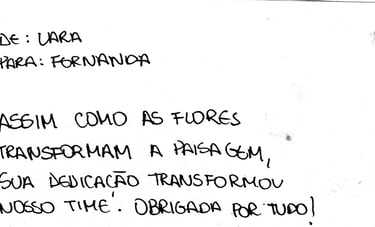
At the end of the project, I received recognition from the e-commerce squad's Design Lead for the results achieved: a handwritten card with the message: "Just as flowers transform the landscape, your dedication transformed our team. Thank you for everything!"
(Featuring Selín, the mascot of the e-commerce squads.)



15 / Key Learnings
Recovering an existing intent can be more effective than starting a new journey: Consultants had already demonstrated purchase intent. Preserving that state reduced the effort required to resume the purchase and turned an operational failure into a new conversion opportunity.
LATAM is more than translating content into Spanish: Designing for different markets requires considering language, time zones, payment methods, integrations, and user profiles.
An MVP is also a product decision: Not every opportunity needs to be addressed in the first version. Prioritizing what delivers immediate value helped maintain focus on purchase recovery.
Accessibility must be part of the process: Collaborating with a visually impaired QA professional reinforced the importance of translating accessibility requirements into actionable guidance for both design and implementation.